

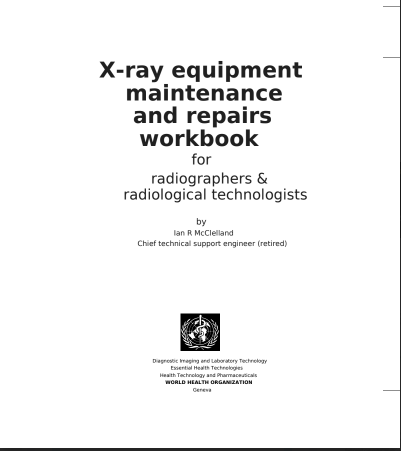
Description
Introduction
accepts that responsibility and ensures that the
programme happens effectively.
This workbook will be used by radiographers and
radiological technologists as well as other medical
and technical staff members involved in diagnostic
imaging, to:
● achieve a good working knowledge of equipment
maintenance routines;
● adopt a logical and practical approach to diagnos-
ing equipment problems;
● on returning to their respective areas after com-
pleted training, teach other members of their staff
to carry out the routines or techniques that they
have learned;
● assist in establishing, or implementing, a suitable
routine maintenance programme;
● be encouraged to directly carry out adjustments
or minor repairs, or provide suitable assistance to
other staff as needed;
● provide accurate reporting of problems to seniors
or service engineers;
● assist in establishing criteria for equipment replace-
ment, where it is not cost effective to continue
maintenance.
Expected benefits
It is expected that after going through the training
and experiences discussed in this workbook, the
knowledge and skills will be put into practise. If so:
● Heads of departments will find that the standard
of radiography will be maintained at the highest
level.
● There will be fewer equipment failures.This reduces
costs.
● Where a failure does occur, local hospital staff may
be able to repair without an expensive service call.
● When an external service call is required, the service
technician can arrive fully informed to deal with the
situation, together with appropriate equipment or
parts. This will reduce the possibility, and expense,
of repeated visits.
PART I. INTRODUCTION
3
It is preferred to call this a workbook rather than a
manual or textbook, because the intent is to, not only
give technical information, but to set practical exer-
cises that students can work through, responding to
specific questions. Above all, the students should feel
that they have actually carried out the tasks them-
selves and will be more confident to teach others and
ensure that these exercises continue to be carried out
in their respective areas.
The topic of this workbook is routine maintenance
and repairs. The material is designed to assist in the
maintenance of equipment, and provide guidelines for
locating equipment problems. In many cases this
will allow local correction of fault situations. Where
external assistance is required, good communication
of the diagnosed problem will assist in reducing delay,
or multiple service calls.
Routine maintenance
The overall maintenance programme;put in place
to ensure that a comprehensive range of mainte-
nance procedures are systematically carried out.
Fault diagnosis and repairs
The means by which the cause of incorrect equip-
ment operation may be located. This includes
adjustment where required, and simple repairs.
A Routine Maintenance Programme should be com-
prehensive, looking at all aspects of the work involved
in ensuring equipment is properly maintained, and
capable of producing accurate results. Such a pro-
gramme can be cost effective, and contribute to
minimum failure of equipment. By encouraging local
staff to be actively involved in maintenance or minor
repairs, delays and expensive service calls may be con-
siderably reduced.
The ultimate responsibility for setting up, running,
evaluating and taking remedial action lies with the
head of department, although appropriate delegation
Reviews
There are no reviews yet.