

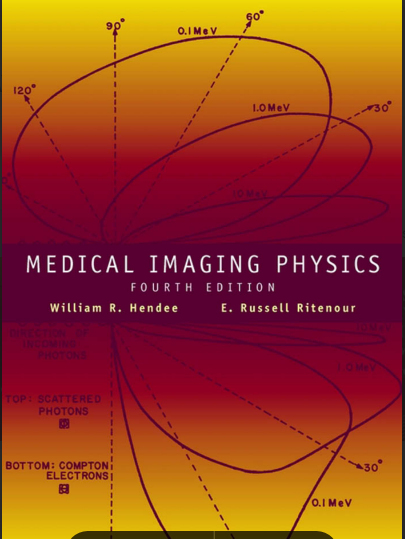
Description
PREFACE
Writing and rewriting a text such as Medical Imaging Physics over
several editions presents two challenges. The first is to keep the
information fresh and relevant. This is a particular challenge in
medical imaging, because the field is evolving so rapidly. The
third edition of this text was published in 1992, just 10 short
years ago. Yet in that text no mention was made of topics such
as photodiode or direct conversion digital x-ray imagers; digital
mammography; digital fluoroscopy; power Doppler ultrasound;
functional magnetic resonance imaging; elastography; or helical
CT scanning. This is just a partial list of imaging approaches that
must be covered today in any text of imaging physics. Being in-
volved in a dynamic and rapidly changing field is one of the more
enjoyable aspects of medical imaging. But it places heavy demands
on authors trying to provide a text that keeps up with the field.
The second challenge is no less demanding than the first. That
challenge is to keep the text current with the changing culture
of how people learn, as well as with the educational experience
and pedagogical expectations of students. These have changed
remarkably over the 30 years since this book first appeared. For
maximum effect, information today must be packaged in various
ways, including self-contained segments, illustrations, highlights,
sidebars, and examples and problems. In addition, it must be pre-
sented in a manner that facilitates learning and helps students
evaluate their progress. Making the information correct and com-
plete is only half the battle; the other half is using a format that
helps the student assimilate and apply it. The latter challenge re-
flects not only today’s learning environment, but also the tremen-
dous amount of information that must be assimilated by any stu-
dent of medical imaging.
In recognition of these challenges, the authors decided two
years ago to restructure Medical Imaging Physics into a fourth edi-
tion with a fresh approach and an entirely new format. This de-
cision led to a total rewriting of the text. We hope that this new
edition will make studying imaging physics more efficient, effec-
tive, and pleasurable. It certainly has made writing it more fun.
Medical imaging today is a collaborative effort involving
physicians, physicists, engineers, and technologists. Together they
are able to provide a level of patient care that would be unachiev-
able by any single group working alone. But to work together,
they must all have a solid foundation in the physics of medical
imaging. It is the intent of this text to provide this foundation.
We hope that we have done so in a manner that makes learning
enriching and enjoyable.
WILLIAM R. HENDEE, Ph.D.
E. RUSSELL RITENOUR, Ph.D.
Reviews
There are no reviews yet.