

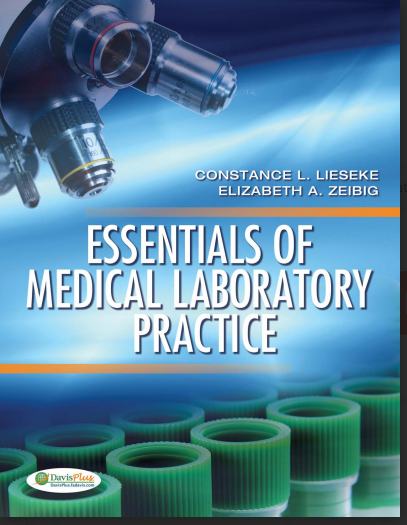
Description
Preface
The clinical laboratory plays an important role in
patient care by providing timely, accurate, reliable
test results to health-care team members. The results
provided by the clinical laboratory are used by appropri-
ate team members to make important diagnosis, treat-
ment, and monitoring decisions. With recent advances
in technology, some laboratory tests may now be per-
formed by appropriately trained individuals in alterna-
tive settings, such as in physician offices. Medical
assistants and phlebotomists may be called upon to
perform this testing. It is thus imperative that individu-
als who collect or oversee collection of samples for
laboratory testing, perform laboratory tests, or interpret
laboratory test results be educated in this important area
of medicine.
The purpose of this text is to introduce the reader to
the clinical laboratory. The text is organized into six
sections. Each of these sections is presented as a com-
plete package. Section I covers the structure and organi-
zation of the clinical laboratory and important consider-
ations, including regulations, safety, quality, legal and
ethical issues, and laboratory equipment. Section II
introduces the importance of techniques associated
with proper specimen collection and handling. The
remaining sections are dedicated to specific laboratory
tests organized by general type: hematology, chemistry,
urinalysis, and immunology.
Each section opens with On the Horizon, an overview
of the chapters in that section. On the Horizon consists
of a content overview, and a description of the relevance
of the content to medical assistants and other health-care
professionals. A patient scenario called Case in Point
follows, and then a series of questions about upcoming
content, called Questions for Consideration. Completing
this section are brief narratives that summarize each
chapter in the section.
Chapters begin with a Chapter Outline for easy refer-
ence. Learning Outcomes appear next. These serve as a
helpful resource to guide readers as they study chapter
content. A list of References to the Commission on
Accreditation of Allied Health Education Programs
(CAAHEP) and the Accrediting Bureau of Health
Education Schools (ABHES) standards appear after the
Learning Outcomes. Key Terms then follow organized in
alphabetical order. Each key term is bolded and defined,
as appropriate, where the term first appears in the text.
Test Your Knowledge sections offer self-assessment
questions coded to the appropriate learning outcomes
and are strategically placed throughout the chapter.
Tables, figures, and procedures coded to CAAHEP and
ABHES standards complement the organized, logically
presented chapter content. Following a chapter sum-
mary readers have an opportunity to review content
through a series of questions and a chapter case study, a
component called Time to Review. A list of resources and
suggested readings is included at the end of each chapter.
The feature What Does It All Mean? is located at the
end of each section and reiterates the purpose of the
section and its importance to medical assistants and
other health-care professionals. The case study intro-
duced in On the Horizon is revisited here and discussed.
This discussion does not include the answers to ques-
tions posed for consideration. The answers to those
questions may be found in the Instructor’s Guide.
An interactive CD-ROM is packaged with this text,
allowing students an opportunity to apply their knowl-
edge in a variety of situations. There are a total of
29 exercises available in the following formats: Don’t Tip
the Scale, Drag and Drop, Multiple Choice, Picture It,
and Quiz Show.
Students will find an additional 12 interactive activities
on the F.A. Davis website at http://www.davisplus.fadavis.
com/ keyword Lieseke. Instructors will find an electronic
test bank, chapter-by-chapter PowerPoints, and numerous
other instructional resources on DavisPlus.
In addition to the core chapter content, a compre-
hensive list of abbreviations is included at the begin-
ning of the book for quick reference. A list of all
CAAHEP and ABHES competencies covered in each
chapter also appears in the front of the book, to quickly
access information about specific procedures. A list
of reference ranges for common laboratory tests are
included in the appendices and a complete glossary

Reviews
There are no reviews yet.