

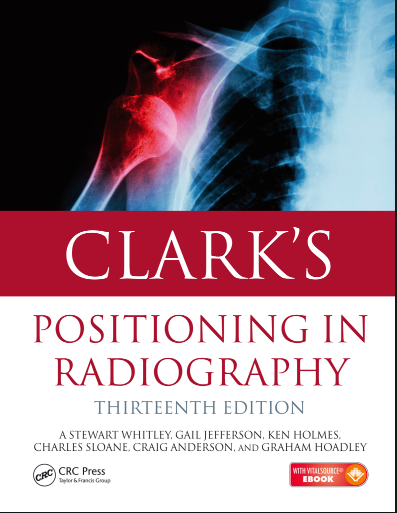
Description
Preface
This new edition, with a newly expanded team, continues with
the success of the 12th edition in containing the majority of cur-
rent plain radiographic imaging techniques in a single volume.
Mammography, however, is not included but is to be found in
the companion volume Clark’s Procedures in Diagnostic Imaging,
where it is included in a separate chapter devoted to all the
imaging modalities associated with breast imaging.
This fully revised 13th edition builds on the changes made
in the 12th edition, reflecting the changing technology and
demands on a modern diagnostic imaging department and the
need to provide optimal images consistent with the ALARP
principle.
New in Chapter 1 is the emphasis on the ‘patient journey’,
with a focus on the needs of the patient and a reflection on
the important steps in the process of delivering images of high
quality.
Also introduced is the formal process of ‘image evaluation’,
which radiographers are frequently engaged in, delivering their
comments on acquired images as part of an ‘initial report’ in
an agreed structure. Additionally, the student is further guided
with the inclusion of a ‘10 Point Plan’ which will aid in ensur-
ing excellent diagnostic images are presented for viewing and
interpretation.
The important role that ‘imaging informatics’ plays is added
to provide a general understanding as to how it is used best,
both to maximise image quality and to provide the means to
administer, store and communicate images where they are
needed.
For the first time recommended diagnostic reference levels
(DRLs) are included within the description of a number of
radiographic techniques. Those quoted are derived from the
recommended references doses published in the UK in the
HPA – CRCE – 034 report Doses to patients from radiographic
and fluoroscopic X-ray imaging procedures in the UK 2010 Review.
For those DRLs not included in the report DRLs are added,
which are calculated on a regional basis by means of electronic
X-ray examination records courtesy of Integrated Radiological
Services (IRS) Ltd, Liverpool. These DRLs are meant to guide
the student and to encourage them to look at the specific DRLs
set in their respective health institutions. This in a small way
reflects the original ‘Kitty Clark’ publications where guidance
on exposure factors was provided. We hope that this will pro-
mote the importance of ‘optimisation’ and encourage practi-
tioners and students alike to be aware of the appropriate dose
for a specific patient-related examination.
The Miscellaneous chapter includes a new section on bari-
atric radiography reflecting the challenges in society and the
need for careful pre-exposure preparation and patient care.
Additionally, the tomography section is expanded to include
tomosynthesis, in order to provide a wider understanding as to
the capabilities of this digital technique.
Overall the book describes radiographic techniques under-
taken using either computed radiography (CR) or direct digital
radiography (DDR) equipment, which continues to advance
both in terms of capability and detector size and weight.
However, there is recognition that screen/film and chemical
processing still exists and this is reflected in some of the text.
With respect to the standard template for the general radio-
graphic technique, the familiar sub-heading
Reviews
There are no reviews yet.