

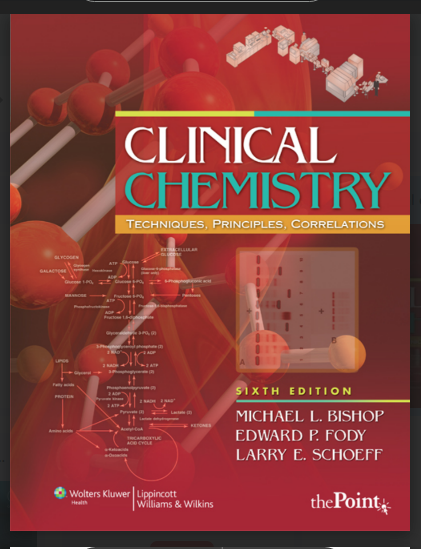
Description
Clinical chemistry continues to be one of the most rap-
idly advancing areas of laboratory medicine. Since the
publication of the first edition of this textbook in 1985,
many changes have taken place. New technologies and
analytical techniques have been introduced, with a dra-
matic impact on the practice of clinical chemistry and
laboratory medicine. In addition, the health care system
is constantly changing. There is increased emphasis on
improving quality of patient care, individual patient out-
comes, financial responsibility, and total quality manage-
ment. For this reason, the editors have replaced
“Procedures” with “Techniques” in the title in order to
reflect the continued evolution of the laboratorian’s role
in healthcare. Point-of-care testing (POCT) is also at the
forefront of health care practice and has brought both
challenges and opportunities to clinical laboratorians.
Now, more than ever, clinical laboratorians need to be
concerned with disease correlations, interpretations,
problem-solving, quality assurance, and cost effective-
ness; they need to know not only the how of tests but
more importantly the what, why, and when.
WHAT’S NEW IN THIS EDITION
The editors of Clinical Chemistry: Techniques, Principles,
Correlations have designed the sixth edition to be
an even more valuable resource to both students and
practitioners.
Like the previous five editions, the sixth edition of
Clinical Chemistry: Techniques, Principles, Correlations is
comprehensive, up-to-date, and easy to understand for
students at all levels. It is also intended to be a practically
organized resource for both instructors and practition-
ers. The editors have tried to maintain the book’s read-
ability and further improve its content. Because clinical
laboratorians use their interpretative and analytic skills
in the daily practice of clinical chemistry, an effort has
been made to maintain an appropriate balance between
analytic principles, techniques, and the correlation of re-
sults with disease states.
In this sixth edition, the editors have made several
significant changes in response to requests from our
readers, students, instructors, and practitioners.
Ancillary materials have been updated and expanded
(see “Additional Resources,” below). Chapters now in-
clude current, more frequently encountered case stud-
Reviews
There are no reviews yet.